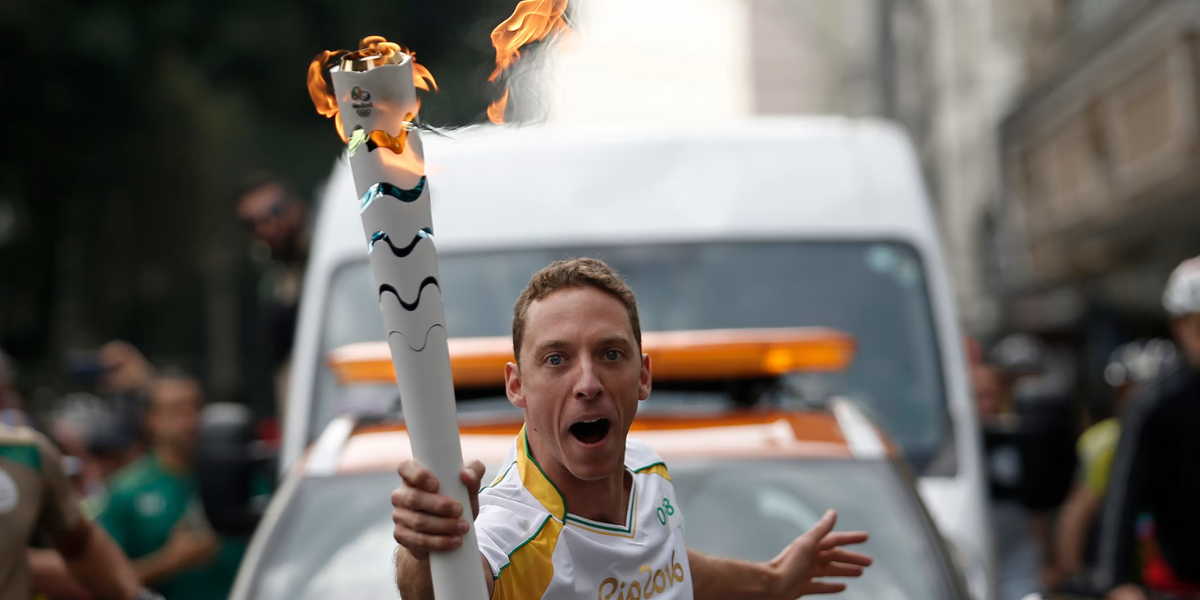
The torch relay has become one of the most recognisable traditions of the modern Olympic Games, symbolising the start of global celebration. Communities along the route host vibrant events that build excitement and invite people to take part in the Olympic spirit.
This custom began with the 1936 Berlin Summer Olympics, while the Winter Games introduced their first relay in Oslo in 1952. From then on, each edition of the Olympics has proudly carried forward this enduring ritual.
Evolution Of The Olympic Torch Relay
The Olympic Studies Centre has described how the method of carrying the torch has evolved in a document titled “Torches and Torch Relays of the Olympic Summer Games from Berlin 1936 to Tokyo 2020.”
While the Olympic flame was once carried mainly by runners, as seen in Berlin in 1936 and London in 1948, the methods of transport have grown remarkably diverse over time. This evolution reflects both practical needs and the unique landscapes the relay passes through. From gondolas gliding through canals to snowmobiles, dogsleds, tractors, horses, camels, and even divers under the sea, the flame has travelled by nearly every imaginable means, says The Olympic Studies Centre.
In keeping with ancient customs, the Olympic flame is lit in Olympia, Greece, through a traditional technique that harnesses sunlight with a parabolic mirror. Among all editions featuring the torch relay, only the first three Winter Games, Oslo 1952, Cortina d’Ampezzo 1956, and Squaw Valley 1960, did not have their relays start from Olympia.
The Hitler Connection
The modern Olympic torch relay began in 1936 at the Berlin Summer Olympics. This was the time when Adolf Hitler was the ruler of Nazi Germany. Author Tony Perrottet, in his 2004 book “The Naked Olympics”, writes, “Ironically, considering its repellent origins, the torch race has come to symbolise international brotherhood today, and remains a centrepiece of our own pomp-filled Olympic opening ceremonies.”
He further wrote, “The Nazis knew a good propaganda symbol when they saw one.”
The concept of the Olympic torch relay was first brought to life by Carl Diem, the chief organiser of the 1936 Berlin Olympics. In that groundbreaking event, the flame was carried through seven countries across a period of 12 days.
When the torch finally reached the Olympiastadion in Berlin, Adolf Hitler personally declared the Games officially open, as documented in Jeremy Fuchs’ “Total Olympics”.
According to the US Holocaust Memorial Museum, the Nazis likened themselves to the ancient Greeks, promoting a myth that a superior German civilisation was the legitimate successor to an ‘Aryan’ heritage rooted in classical antiquity. Adolf Hitler intended to use the Olympic torch as a powerful propaganda tool, similar to the torchlit parades and rallies regularly held by the Nazi Party to attract both young people and adults to their cause.
This deliberate symbolism was part of the broader effort to link Nazi ideology with an idealised image of ancient Greek culture and to legitimise their regime through historical association.
“Germany skillfully promoted the Olympics with colourful posters and magazine spreads. Athletic imagery drew a link between Nazi Germany and ancient Greece. These portrayals symbolised the Nazi racial myth that superior German civilisation was the rightful heir of an ‘Aryan’ culture of classical antiquity,” writes the US Holocaust Memorial Museum.
Recent History And Controversies
Over time, the Olympic torch relay has been separated from its origins tied to the Nazi regime. However, it has occasionally provoked debate and controversy throughout the years, as per reports in Time magazine and the Associated Press.
For the 1994 Winter Olympics held in Lillehammer, Norway, the torch relay took a unique approach: the main flame was lit in Greece as tradition dictates, but a second flame was also kindled within Norway itself. This move did not sit well with the Greeks, who value the tradition of a single origin for the Olympic flame and felt this dual lighting conflicted with the established custom.
The 1984 Los Angeles Olympics marked a shift towards the commercialisation of the torch relay. AT&T, the lead sponsor, introduced a programme allowing individuals or groups to purchase “kilometre legs”, granting them the opportunity to carry the torch, as per the Associated Press.
Dr Bill Mallon, a former president of the International Society of Olympic Historians, told the Associated Press, “Greece was not happy with that in 1984 and threatened to not let Los Angeles light their flame in Olympia.”
“It was enough of a problem that Peter Ueberroth (chairman of the organising committee) and Juan Antonio Samaranch (IOC president) actually made contingency plans for the relay in case the Greeks held to their threat. They eventually backed off and the flame was lit in Ancient Olympia in 1984,” he added.During the 2008 Beijing Olympics, the torch relay faced significant challenges. The route included not only a domestic journey across China but also a worldwide lap, which encountered protests against China and for Tibetan independence at roughly half of the stops.
Taiwan chose to boycott the relay after China attempted to incorporate it as part of the domestic route, a move seen as asserting Chinese sovereignty over the self-governing island.