

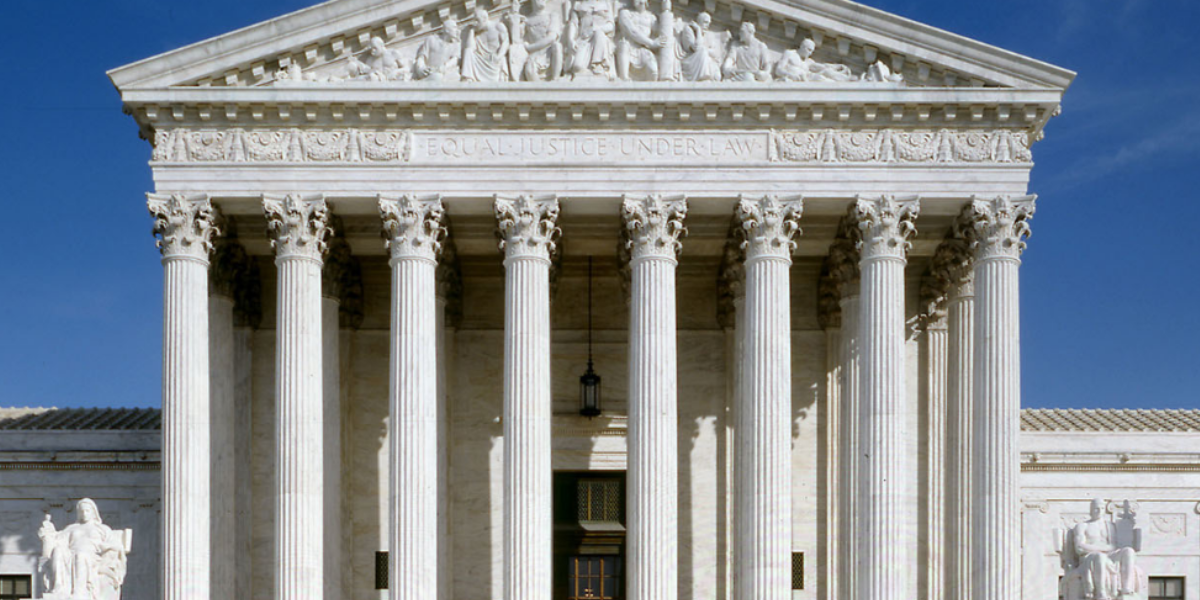
The Supreme Court of the United States (SCOTUS) is the highest court in the country. It has the final say on all legal matters involving the federal laws and the Constitution.
The top court doesn’t make the rules or enforce them but decides whether they’re fair, legal, and in line with the Constitution.
What does the Supreme Court in the US do?
The words “Equal Justice Under Law”, written above the main entrance of the US Supreme Court building in Washington, DC, epitomise what it stands for – everyone should be treated fairly, regardless of their status, race or gender.
The Court acts as a guardian of justice, ensuring the government actions do not violate anyone’s rights and follow the Constitution. The court doesn’t make laws; it’s the job of Congress, nor does it enforce them, for that’s the Presidents do. But it interprets the laws.
If a law violates the Constitution, the Court strikes it down. It also settles disputes between states, hears cases about federal laws, and checks if lower courts have applied the law correctly.
Composition of the Supreme Court
Initially, the US Constitution didn’t mention the number of justices to be on the Supreme Court. The decision was left to Congress, the law-making body. In 1789, Congress passed the Judiciary Act, which decided the six justices at the time, including one chief justice.
As the US grew and the SC faced more cases, Congress increased the number of justices under the Judiciary Act of 1869. Now, the Supreme Court has nine justices, consisting of one Chief Justice and eight Associate Justices.
Justices are nominated by the President and approved by the Senate. Once selected, they serve for life, unless they die, choose to retire, resign or are removed through impeachment.
Lifetime appointments are meant to keep justices independent, so they can make decisions without worrying about politics or elections. Each justice has a single vote in deciding the cases argued before the court.
As of November 6, 2025, Clarence Thomas is the longest-serving justice, with a tenure of 34 years and 14 days (12,433 days).
How does the Supreme Court take up cases?
Every year, the Supreme Court receives around 10,000 petitions, but it cannot handle that many cases. So, the Court uses the “Rule of Four”, which means if four out of the nine justices think a case is important, the Court will agree to hear it.
When a case is accepted, the Court issues a writ of certiorari, an official order asking a lower court to send all the case records up for review. Even though thousands of petitions are filed, the Court only hears about 75 to 85 cases each year.
Most cases the Supreme Court hears are appeals from the lower court and usually come from the federal courts of appeals.
The cases the Supreme Court chooses are usually national disputes that affect the entire country. The Court often hears cases involving constitutional rights, federal laws, or disagreements between lower courts.
Briefing, oral arguments and decision making
Once the court agrees to hear a case, both sides submit written arguments called briefs where they explain their case in a summarising way which helps the court in deciding the case. After the briefs are submitted, the Court schedules oral arguments, where lawyers for each side present their case in person.
After hearing the case, the justices vote. A majority vote, at least five out of nine, is required for a decision. Justices who disagree may write a dissenting opinion, explaining why they believe the majority is wrong. Justices may also write a concurring opinion, agreeing with the outcome but for different legal reasons.
Diversity Jurisdiction
Sometimes, a case is based on state law, for example, a contract dispute or personal injury, but involves people from different states. In such situations, federal courts can hear the case under a rule called “diversity jurisdiction.”
For a case to qualify for diversity jurisdiction, the plaintiff must be from a different state than the defendant. In addition, all plaintiffs must be from different states than all defendants, and the amount in controversy must exceed $75,000.
However, diversity jurisdiction does not apply to criminal cases, as state courts handle violations of state law, while federal courts handle violations of federal law.