

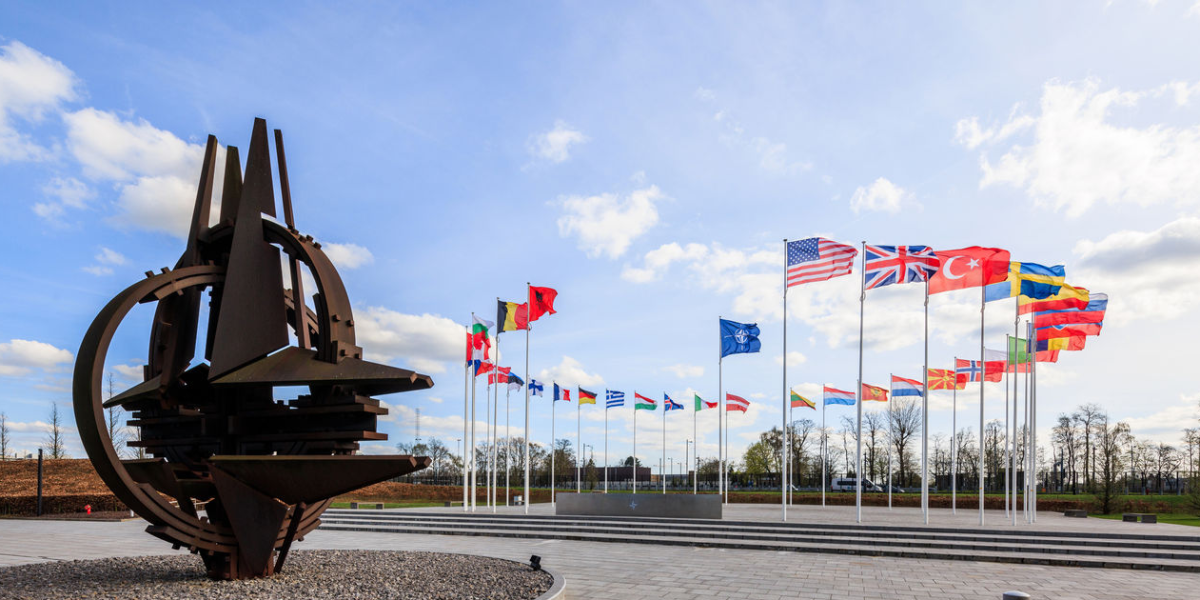
An attack on a single country can trigger a response from 30 others across Europe and North America and that is the power of NATO. The North Atlantic Treaty Organization (NATO), a military alliance, was founded in 1949 to ensure that peace and security are never threatened again on the scale of World War II.
So, if one member is attacked and all other members consider it an attack on themselves and respond together. NATO was created after World War II when Western countries, led by the United States, wanted to protect themselves against the Soviet Union and prevent the spread of communism in Europe.
Today, it has expanded beyond Europe and North America and includes 32 member countries, including the United States, Canada, the United Kingdom, Germany, and France.
What does NATO do?
NATO is mainly a defensive military alliance, which means its main job is to protect its member countries from attacks. But NATO isn’t just about soldiers and weapons. Diplomacy comes first. This means that NATO focuses on talking and negotiating with each other and with other countries to try to solve problems without war.
Inside NATO, the member countries, called Allies, work together and make agreements on important issues. The major focus is protecting democratic values such as free and fair elections, equal rights for everyone and freedom of speech.
NATO partnerships
Over the last two decades, NATO has built a network of partnerships with many countries around the world. These partnerships aren’t the same as full membership but they are countries that work closely with NATO without being formal members.
Some partner countries are in the Euro-Atlantic area, others are in the Mediterranean region, and some are in the Gulf region. NATO also has individual relationships with countries in other parts of the world. NATO also works with other international organizations, like the United Nations or the European Union, on political and security matters.
Structure of NATO
NATO is a big alliance of countries, and to make it work smoothly, it has a clear structure. This structure helps the member countries make decisions, plan defence strategies, and respond quickly to threats.
The North Atlantic Council (NAC) is the main decision maker which is the main political body of the alliance made up of representatives from all member countries. The NAC makes the big decisions about NATO’s policies, crisis responses, and international cooperation. Decisions are made by consensus, which means that all member countries need to agree before action is taken.
Then there is the Military Committee, which is composed of Chiefs of Defence from each member country. Their main role is to advise the NAC on military strategy and planning. They make sure that NATO forces are prepared, trained, and able to operate together efficiently.
After that comes the Defence Policy and Planning Committee (DPPC) which serves primarily for the analysis of the defense expenditures of the member states. In addition to this, is the Nuclear Planning Committee (NPG) that consults on all issues related to the role of nuclear forces in the body’s security and defense policy.
Then comes the Secretary General who is the main spokesperson and the highest political international representative of NATO and the chairman of the North Atlantic Council, the Defense Planning Committee and the Nuclear Planning Group.
Now, NATO has two main strategic commands that handle operations and planning. The Allied Command Operations (ACO), based in Belgium, is responsible for all NATO military operations worldwide, and the other is the Allied Command Transformation (ACT), based in the USA, which focuses on preparing NATO for the future by working on developing new technologies.
NATO works not only through governments but also through parliamentary and non-governmental organizations. The NATO Parliamentary Assembly (NATO PA) is a forum for members of parliament from all NATO countries.
Since 1955, it has allowed lawmakers to discuss security and defense issues, share political opinions, and strengthen cooperation. It has 188 members, with representation based on each country’s population.
It also has the Atlantic Treaty Association (ATA) which is a non-governmental organization made up of voluntary national groups that support NATO’s goals.
Role of NATO in 21st century
Originally established to protect Europe from Soviet aggression, NATO has evolved into a global security alliance that addresses current issues such as cyberattacks, terrorism, climate change, and artificial intelligence.
The alliance focuses on defending member countries not just from military invasions but also from terrorism, cyber warfare, and hybrid threats.
NATO now believes that cyberattacks can be just as dangerous as physical attacks. For example, if hackers attack a NATO country’s power grid, airport system, or army computers and cause serious damage, NATO will treat it like a real military attack.
NATO’s role in the 21st century has had to evolve in response to new conflicts and threats that were not covered by the original treaty.
When can a country join NATO?
A country can join NATO if it meets certain political, military, and legal criteria agreed upon by existing members. NATO membership is voluntary, and a country must apply and be accepted by all current member states.
A country can join NATO if it is a democracy, has capable armed forces, follows NATO rules, resolves conflicts peacefully, and gets approval from all existing members.