

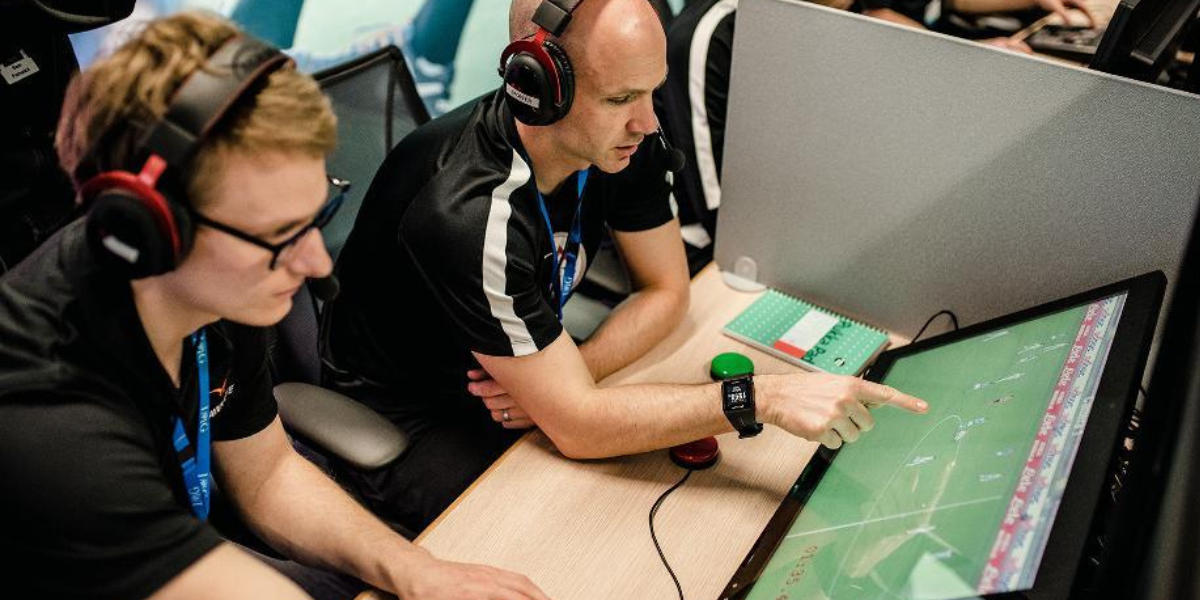
In contemporary sports, technology has become an indispensable ally for officials. It has transformed the way games are officiated. For the sports enthusiast, appreciating these advancements enriches understanding of how fairness and accuracy in sports have been revolutionised, be it in cricket, football, or other popular games.
Technologies That Have Improved Sports Officiating
Video Assistant Referee (VAR)
The introduction of the Video Assistant Referee (VAR) in football has been one of the most high-profile and controversial changes.
A team of video officials constantly monitors the match from a control room. They review incidents for four key ‘game-changing’ situations: goals and offences leading up to a goal, penalty decisions, direct red card incidents, and cases of mistaken identity.
While it sometimes slows the pace, VAR has undeniably reduced errors in major tournaments, ensuring decisions on goals and penalties are more accurate.
Decision Review System (DRS)
The DRS, or Decision Review System, is a system used in cricket to help officials make better decisions. It allows players to challenge on-field umpire decisions and umpires to consult the third umpire on certain calls, using tools like ball-tracking, slow-motion replays, and audio analysis. The primary goal of the DRS is to reduce human error and increase the fairness and accuracy of decisions in a match.
Hawk-Eye
The Hawk-Eye system uses multiple camera angles to deliver real-time tracking of ball trajectories in competitive sports. It is used in several sports such as football, tennis, snooker and cricket.
In tennis, Hawk-Eye has virtually eliminated arguments over whether a ball was ‘in’ or ‘out’.
Here’s a video which explains the evolution of the technology:
Goal-Line Technology (GLT)
The Goal-Line Technology is used in football to judge whether the entire ball has crossed the goal line. It provides immediate, accurate feedback on the referee’s watch to confirm goals, eliminating human error in crucial moments. It is essentially a form of Hawk-Eye.
“The system uses 14 high-speed cameras mounted on the catwalk of the stadium/under the roof. The data from the cameras is used to create a 3D animation to visualise the decision to the fans on TV and on the giant screen inside the stadium,” as per FIFA’s official webpage explaining the technology.
Semi-Automated Offside Technology (SAOT)
Semi-automated offside technology aids the video assistant referee by automating critical parts of the offside review process. It is deployed in tight offside situations to either validate or challenge the on-field referee’s decision,
“The technology is ‘semi-automated’, meaning there is human input as the VAR still needs to confirm the decision and that the SAOT system has accurately identified the ‘kick-point’ and the correct players with the correct part of the body – and the outcome of the SAOT,” the Premier League says on its official website.
Hot Spot
This technology is used in cricket to confirm contact between bat and ball. It uses highly sensitive thermal imaging cameras. When the ball makes contact with the bat, the friction generates heat, which shows up as a bright white spot on the thermal image. It helps umpires decide on catches or LBWs.
The Challenges And The Human Element
The growing reliance on technology in officiating has not been without controversy, especially for fans accustomed to the thrill of uninterrupted action.
- The Pause in play: Stopping the game for lengthy reviews can break the momentum and dampen the atmosphere in the stadium. The trade-off is often accuracy versus entertainment flow.
- Interpretation remains key: Technology does not remove human judgment from the equation. Video systems may pinpoint the location of an incident, but officials must still interpret those findings within the framework of the laws of the game.
- Access and cost: Implementing systems like DRS and Hawk-Eye is expensive, creating a potential divide between top-tier leagues and smaller, domestic competitions.
How Artificial Intelligence Could Redefine Officiating
The influence of artificial intelligence on refereeing is only just beginning to be felt, but its long-term impact could be transformative. As systems become more accurate and reliable, acceptance across different sports is likely to grow.
In some sports, AI may eventually assume full control of officiating, reducing reliance on human judgment. Elsewhere, augmented reality tools could support referees by offering instant, AI-generated visual insights, while also giving viewers a clearer picture of contentious decisions.
At the same time, AI decision-making tools are expected to become more sophisticated, drawing on advanced machine learning to interpret complex rules and on-field behaviour with greater precision. As costs fall, these technologies could also trickle down to grassroots sport, helping to deliver fairer outcomes well beyond elite competitions.
In conclusion, technology isn’t replacing the human referee, but rather empowering them to make better decisions. The official remains the ultimate authority, armed with a powerful new assistant. As these systems become faster and more integrated, the debate will shift from “Was that the right call?” to simply enjoying a fairer, more accurately adjudicated game.