

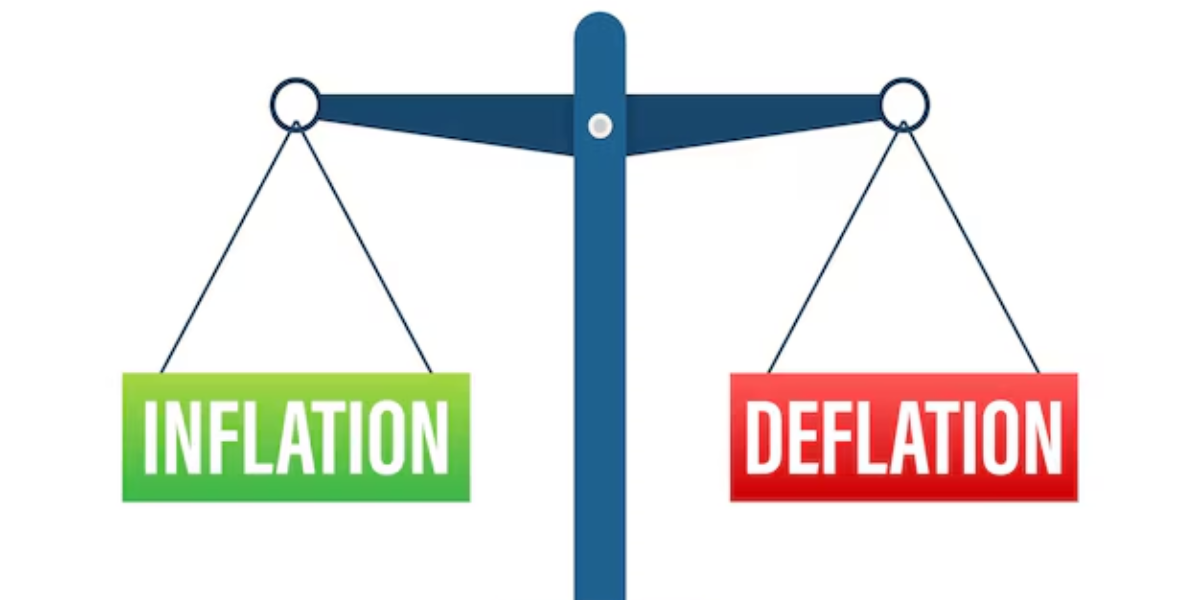
Why does your grocery bill rise each year? Why do some prices sometimes fall instead? The answers lie in the economic forces of inflation and deflation. These shifts in prices influence your savings, spending, and the overall health of the economy.
While a 10 per cent increase in the price of your favourite snack may seem like a small annoyance, it shows inflation at work. Conversely, if that same snack costs 10 per cent less a year later, deflation is at play.
These phenomena show the ebb and flow of an economy. In 2026, global inflation is projected to fall to 3.5 per cent from 4.2 per cent in 2025, as per an IMF report.
Deflation, though rarer, has historically caused severe economic disruptions, such as during the Great Depression when prices fell by over 10 per cent. It began in the United States in 1929 after the stock market crash and then spread to many countries around the world, including Canada, the United Kingdom, Germany, France, and several others.
What Is Inflation?
Inflation is the sustained increase in the general price level of goods and services over time. When inflation occurs, the purchasing power of money declines. It means each unit of currency buys fewer goods and services than before. Economists express inflation as a percentage change in prices, typically measured over a year.
Causes Of Inflation
- Demand-Pull Inflation – This occurs when demand for goods and services outpaces supply. High demand in a limited supply environment drives up prices.
- Cost-Push Inflation – Rising costs of production such as wages, raw materials, or energy can lead companies to increase prices to maintain profit margins.
- Increased Money Supply – When the money supply grows faster than the economy can produce goods and services, too much money chases too few goods, leading to inflation.
- External Factors – Global commodity price hikes, tax adjustments, and tariffs can push domestic prices higher. For example, a spike in oil prices raises transportation costs, which then reflect in consumer goods.
What Is Deflation?
Deflation is the opposite of inflation, i.e, a general decline in prices over time. Initially, falling prices may seem beneficial because your money can buy more. Sustained deflation can signal economic weakness, often leading to a slowdown in production, investment, and employment.
Causes Of Deflation
- Fall in Aggregate Demand – When overall spending declines, prices drop. Recessions often trigger this behaviour as households and businesses cut back on expenditures.
- Increase in Aggregate Supply – Improved efficiency or lower production costs can result in excess supply. Companies lower prices to attract buyers, which can further drive deflation.
- Tight Monetary Policy – Central banks may raise interest rates to control inflation, reducing the money supply. If overdone, this can tip the economy into deflation.
- Decline in Confidence – During periods of uncertainty, consumers and businesses save more and spend less, reducing demand and putting downward pressure on prices.
Example – Japan’s “Lost Decade” in the 1990s saw prolonged deflation, stagnant growth, and rising unemployment.
Inflation usually encourages people to spend and makes debt easier to manage, whereas deflation makes people save more and increases the real burden of debt. Both can have some benefits in small amounts, but if either becomes too extreme, it can hurt the economy.
Related Concepts: Disinflation and Stagflation
Disinflation
A slowdown in the rate of price increases. Prices continue to rise but more gradually, often reflecting a balanced economy.
Stagflation
A rare but challenging situation where high inflation coincides with slow growth and high unemployment. Policymakers struggle to tackle this scenario because tools that curb inflation may worsen unemployment.
How Central Banks Manage Inflation And Deflation
Central banks aim to maintain price stability using monetary policy tools like interest rates, open market operations, and money supply management. Their goal is to ensure moderate price changes that support economic growth without triggering instability.
Key Measures
- Consumer Price Index (CPI): Measures changes in the prices of a standard basket of consumer goods and services. It’s the most common gauge of inflation and guides policy decisions.
- GDP Deflator: The GDP deflator is a broad measure of inflation that shows the price changes of all domestically produced goods and services in an economy. It shows how much of the rise in nominal GDP is due to higher prices rather than increased output. It is calculated using the formula: GDP Deflator = (Nominal GDP / Real GDP) × 100.
Using these tools, central banks attempt to balance growth, employment, and price stability, preventing the economy from overheating or falling into prolonged stagnation.
Consequences Of Inflation And Deflation
Inflation
- Reduces purchasing power.
- Can boost business profits if prices rise faster than costs.
- Encourages spending and investment when moderate.
- Hyperinflation (monthly price increases above 50 per cent) can devastate economies, as seen historically in Zimbabwe.
Deflation
- Increases the real value of money.
- Can reduce spending as consumers anticipate lower future prices.
- Often leads to higher unemployment due to declining business revenue.
- Risk of a deflationary spiral, potentially causing recessions or depressions.