

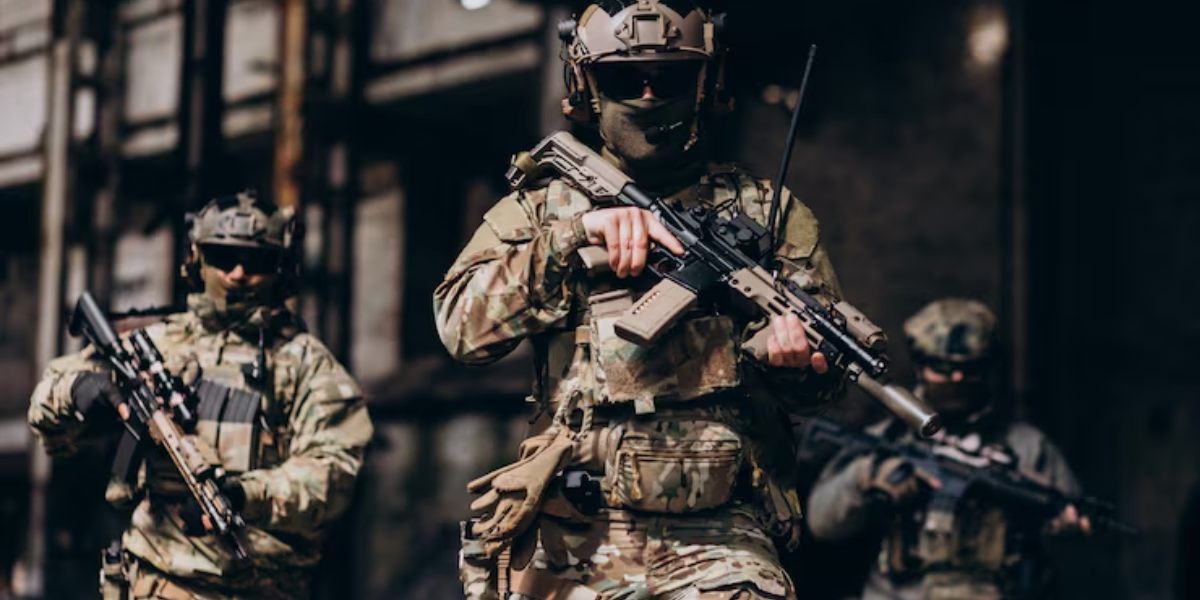
There is a clear legal boundary between the role of the military and the role of civilian authorities in US. This is defined in the Posse Comitatus Act which restricts the use of federal armed forces in everyday law enforcement within the country.
This means that soldiers cannot be used to perform duties that are usually handled by police or other civilian agencies.
Where Does The Term Come From?
According to Brenan Center For Justice, the phrase “posse comitatus” has its roots in older legal systems in Britain and US. It refers to a group of local civilians called “posse” brought together by a sheriff to help deal with crime or unrest.
Why Was Posse Comitatus Act Passed?
Introduced in 1878 after Reconstruction ended and political control changed in southern states, Posse Comitatus Act was aimed at preventing the use of federal military forces in influencing systems such as Jim Crow laws in the former Confederacy.
What Does Posse Comitatus Act Actually Say?
The law says, “Whoever, except in cases and under circumstances expressly authorized by the Constitution or Act of Congress, willfully uses any part of the Army, the Navy, the Marine Corps, the Air Force, or the Space Force as a posse comitatus or otherwise to execute the laws shall be fined under this title or imprisoned not more than two years, or both.”
In practical terms, this means that federal troops cannot be used to enforce laws inside the country unless there is a clear legal exception.
Who Does It Apply To?
The law applies to the main branches of US armed forces that includes the Army, Navy, Air Force, Marine Corps and Space Force. But there are some important distinctions.
The Coast Guard is not restricted in the same way because it already has legal authority to carry out law enforcement duties.
The National Guard operates differently as well. Most of the time, it functions under the control of individual state governments which means it can assist in law enforcement if state laws allow it. But if National Guard troops are placed under federal control, they then fall under the restrictions of the Posse Comitatus Act.
Are There Exceptions To The Rule?
Yes, but these exceptions are clearly defined. As per Brenan Center, one of the most important is the Insurrection Act. Under this law, the president can send military forces into a state if its government requests help to deal with an uprising.
It also allows the president to act without a state’s approval in certain situations, such as enforcing federal laws, responding to rebellion against federal authority or protecting civil rights when local authorities are unable or unwilling to act.
What About Constitutional Authority?
The Posse Comitatus Act does not clearly provide any direct constitutional exceptions. It only allows the use of the military in situations that clearly written in legislation. At the same time, the US Constitution itself does not specifically give the president the power to use federal troops for enforcing domestic laws.
This understanding is also supported by how the law was framed. Historical records suggest that the reference to constitutional exceptions was included “as part of a face-saving political compromise, not because they believed any existed,” the Brenan Center noted.
But the absence of clearly defined constitutional exceptions has not stopped the US government from putting forward its own interpretations.
Over the years, the Department of Defense has argued that there may be limited emergency powers under the Constitution. According to this view, military commanders could act on their own in urgent situations (like in controlling large and sudden civil disturbances) if immediate action is considered necessary and there is no time to obtain prior approval from the president.
These claims, however, remain legally uncertain, as courts have not definitively ruled on whether such authority exists.
At different points, the government has also argued that the military can be used to protect federal property and operations if local authorities fail to do so. Although the rule supporting this idea was withdrawn in 2018, the argument has been raised again in legal proceedings.