

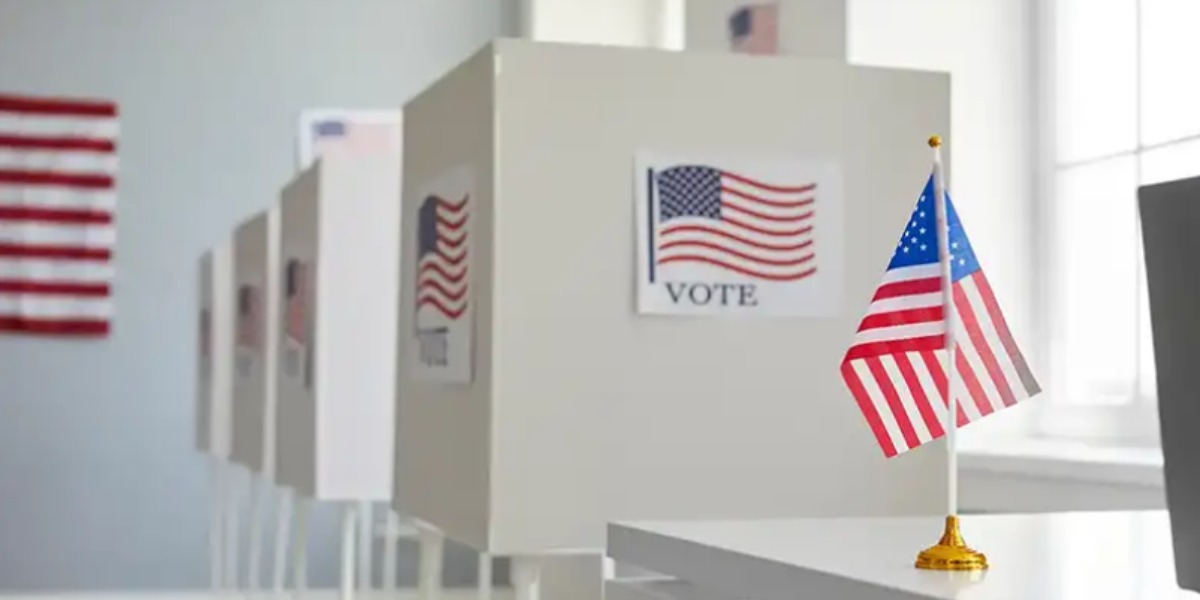
In what’s not the most direct electoral system, Americans step out once every four years on a Tuesday in the month of November to cast their ballot. These votes influence a group of state-appointed electors who formally choose the President and Vice President. This process is known as the Electoral College.
What Is The Electoral College?
The Electoral College is not a place; it is a procedure established by the US Constitution as a compromise between direct popular vote and election by Congress. Its purpose is to balance the influence of states and citizens in selecting the nation’s executive leaders.
How Does The Electoral College Process Work?
The process involves three stages: the selection of electors, the meeting of electors to cast votes for the President and Vice President, and the counting of electoral votes by Congress.
Each state is given as many electors as it has members in the total Congress, combining both the House of Representatives and the Senate. With three electors for Washington, D.C., treated as a state by the 23rd Amendment, there are currently 538 electors. The winner in any presidential election must receive at least 270 electoral votes to achieve a majority.
Who Are The Electors?
Electors are selected by the political parties of each state. The way and the date of their selection also differ from state to state. Typically, these electors are party loyalists entrusted to cast their votes for the candidate who receives the popular vote in their state.
Once voters cast their ballots for President, the results are tallied at the state level. In 48 states and Washington, D.C., the winner of the most votes gets all of the electoral votes for that state, a process often called “winner-takes-all.” Maine and Nebraska do not use this process. These states divide their electoral votes proportionally based on congressional district results.
When Do Electors Vote?
Though media outlets often project a winner on election night, the official Electoral College vote occurs in mid-December. Electors meet in their respective states to formally cast votes for President and Vice President. These votes are then transmitted to Congress for the final counting.
Can Electors Vote Differently From Their State’s Popular Vote?
The Constitution does not mandate electors to follow the popular vote. Nevertheless, most states enforce rules requiring electors to vote according to the state’s outcome. Those who attempt to vote otherwise, known as “faithless electors,” may face fines, disqualification or legal action.
What Happens If No Candidate Wins A Majority?
When no one receives the 270 votes required, the decision shifts to the House of Representatives. Very rarely, no candidate will acquire the needed 270 electoral votes. This has only happened twice in American history, once in 1800, when Thomas Jefferson was selected, and again in 1824 when John Quincy Adams was elected President.
Is It Possible To Win The Popular Vote But Lose The Election?
Yes, a presidential victory can happen without a candidate winning the national popular vote. Candidates can prevail by winning a series of narrow state victories even if they receive fewer votes nationwide. This has most recently occurred with George W. Bush in 2000 and Donald Trump in 2016, as both presidential candidates ultimately prevailed without winning the popular vote.
Why Is It Called A ‘College’?
The term ‘college’ in this context describes the group of electors assigned to cast each state’s official votes. Together, they determine the outcome of the presidential election. The system is used only for presidential elections. Every other election in the United States is determined by a simple popular vote.
Can The Electoral College System Be Changed?
Because the Electoral College is enshrined in the Constitution, altering it requires a constitutional amendment. Citizens can contact their US senators or representatives for more information about pursuing changes to the system.
What Are Some Unusual Electoral College Scenarios?
Other than the cases where a winner of the popular vote loses, other unusual situations include tied electoral votes and an election decided in the House of Representatives. Though they are rare, these show how the system can give a result quite different from a direct popular vote.
How Does The Electoral College Reflect The Founders’ Intent?
The system was designed to balance the influence of populous states with smaller states, ensuring that all regions have a voice in presidential elections. It also sought to create a buffer between the electorate and the selection of the executive, providing a measure of deliberation through state-appointed electors.
What Is The Overall Significance Of The Electoral College?
The Electoral College remains central to American presidential elections. It translates the preferences of voters within each state into a decisive vote for the nation’s highest offices. While controversial at times, it continues to shape campaign strategies, voter engagement and the distribution of political power across the country.