

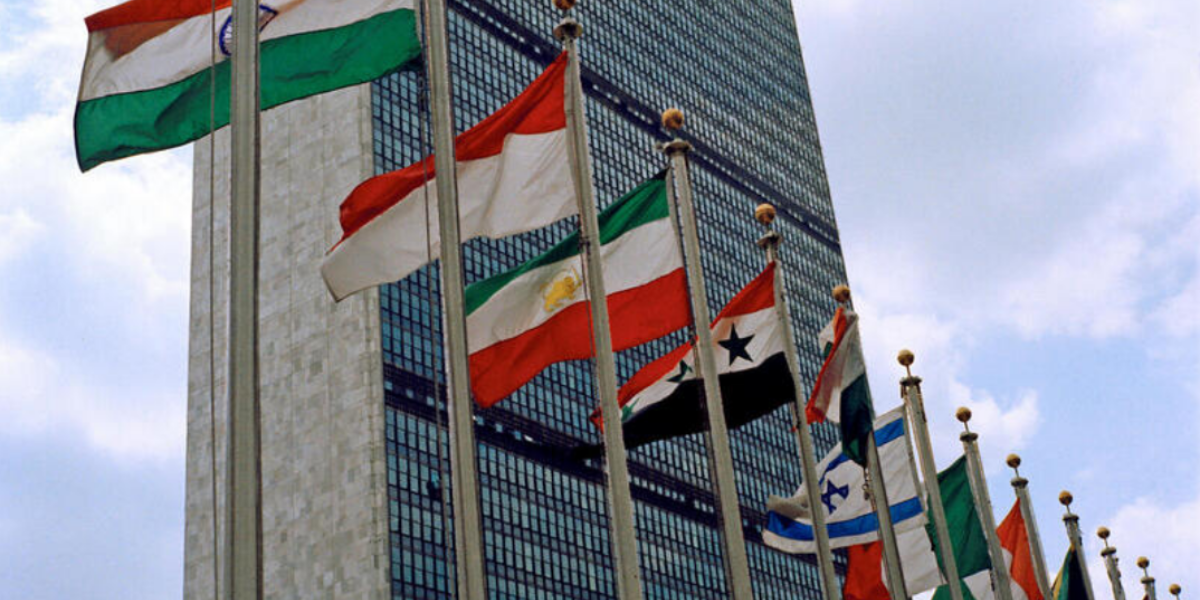
The United Nations (UN) was born out of the desire to prevent the kind of destruction that had plagued the world during the first half of the 20th century. The devastation caused by World War I and World War II left nations seeking an international body dedicated to maintaining peace. Shortly after the Paris Peace Conference in January 1919, the Covenant of the League of Nations was adopted.
Although the League ultimately failed to achieve the ambitions of its founders, it remained in force until 1946. The lessons learned from the League laid the groundwork for the creation of a stronger, more effective organisation: the United Nations.
Early Steps Towards The UN
The path to establishing the UN began during the turmoil of World War II. By June 1941, Europe had largely fallen under Axis control (Germany, Italy, and Japan, along with their allies). On 12 June 1941, representatives from the Allied nations met in London and signed the Declaration of St James Palace, pledging to fight aggression.
It said, “The only true basis of enduring peace is the willing cooperation of free peoples in a world in which, relieved of the menace of aggression, all may enjoy economic and social security.”
Two months later, on August 14, 1941, US President Franklin D Roosevelt and UK Prime Minister Winston Churchill issued the Atlantic Charter. It was not a treaty but outlined principles for a better world, including:
- No territorial changes without the freely expressed wishes of the people.
- Every person’s right to choose their government.
- Equal access to resources for all nations.
The Charter inspired hope and pointed towards a world organisation based on moral principles.
The Declaration By United Nations
On January 1, 1942, Churchill, Roosevelt, Maxim Litvinov of the USSR, and T V Soong of China signed the Declaration by United Nations. The next day, 22 more nations joined. They promised to follow the Atlantic Charter and not make separate peace deals with the Axis.
The original 26 signatories included the United States, United Kingdom, USSR, China, India, Canada, and Australia. Later, countries like France, Iran, Brazil, and Saudi Arabia also joined. This was the first time the term “United Nations” was officially used to describe the Allied nations.
Planning The UN
By 1944, the Allies agreed on the need for a new international organisation. At the Dumbarton Oaks Conference, representatives from China, the UK, USSR, and the US proposed the UN’s structure:
- A General Assembly with all members.
- A Security Council with five permanent members and six rotating members.
- An International Court of Justice.
- A Secretariat.
- An Economic and Social Council under the GA.
The Security Council would prevent wars, and member states were to provide forces to act against aggression. The Yalta Conference in February 1945 finalised voting rules and called for the San Francisco Conference to draft the UN Charter.
The San Francisco Conference And Birth Of The UN
From April 25 to June 26, 1945, 50 nations met in San Francisco to write the UN Charter. One major debate was about the veto power of the Security Council’s permanent members. Smaller countries worried the veto would make the Council ineffective, but the big powers insisted they needed this authority.
On June 25, the Charter was unanimously passed, and the next day it was signed, with China signing first. The UN officially came into existence on October 24, 1945, once the major countries ratified it.
Security Council And The Veto Power
The Security Council maintains international peace. Its five permanent members, China, France, Russia, the UK, and the US, have the veto, which allows them to block any resolution.
The veto came from post-World War II planning. Leaders wanted major powers to play a decisive role in global security, learning from the League of Nations’ failures. Article 27 of the UN Charter says substantive decisions need nine affirmative votes, including the concurring votes of all five permanent members.
Veto Uses And Criticism
Since 1945, the veto has been used over 300 times. During the Cold War, the USSR often used it to block Western-aligned countries, and the US used it to protect Israel. After 1991, veto use decreased but later increased due to conflicts in the Middle East, Syria, Ukraine, and Israel-Palestine. Critics argue that the veto protects the interests of P5 members and stops the UN from acting in crises. Examples include the UN’s inability to prevent the Rwandan genocide (1994) and the ongoing war in Syria (2011-present). Some also point out that the P5 reflects 1945 power dynamics and not today’s world. Countries like India, Brazil, and South Africa have called for a more inclusive Security Council.
Reform Efforts
Many proposals aim to reform the veto. One idea is the “responsibility not to veto”, limiting veto use in cases of genocide and mass atrocities. Another would require at least two P5 members to veto a resolution.
The Small Five (S5) and later the ACT group have pushed for better Council practices, including voluntary limits on the veto. By January 1, 2020, 120 countries supported the Code of Conduct, including France and the UK. France has long promoted voluntary restraint, organizing meetings with Mexico and other nations. Among permanent members, only the UK publicly supported this effort.