

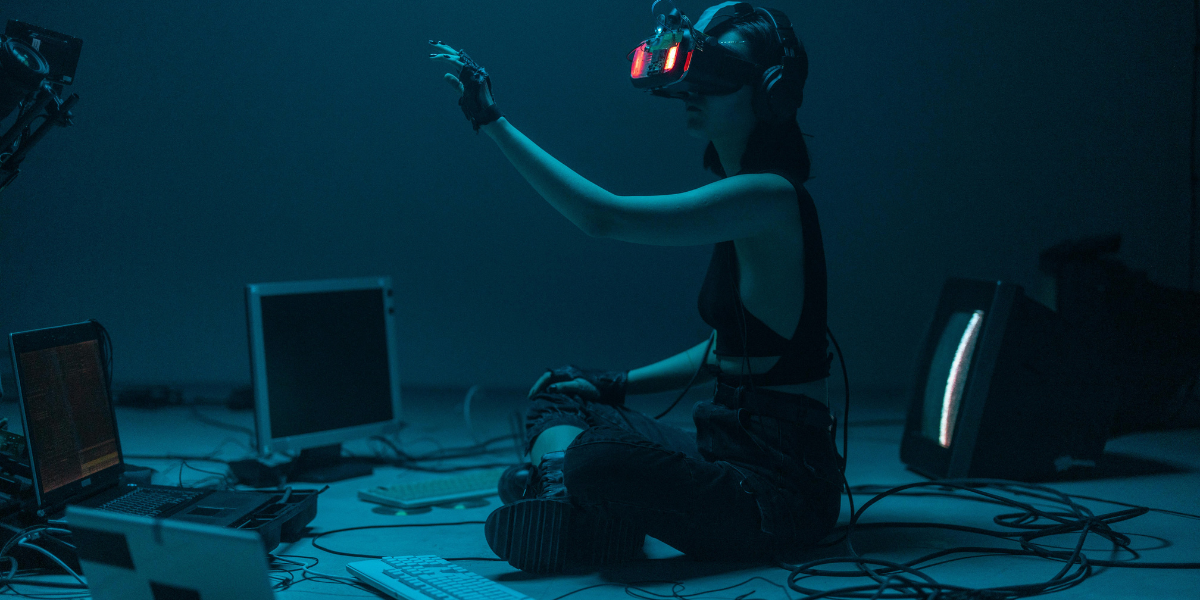
Imagine wearing a headset or a pair of smart glasses and instantly stepping into a world that looks and feels real. You could walk through digital streets, meet friends as avatars, attend a live concert, play games, or even run a virtual shop.
This idea, a mix of the digital and physical world, is what we call the metaverse. Think of it as a 3D version of the internet, where instead of just watching content, you enter and experience it.
Origins Of The Metaverse
The term metaverse was introduced by Neal Stephenson in his 1992 sci-fi novel Snow Crash. In the book, the metaverse was a huge virtual reality world where people could log in using goggles, create avatars, and live a second digital life.
As technology improved, parts of this fiction slowly became real. Early virtual worlds, social gaming platforms, and online communities showed how people could interact digitally through avatars. By the 2010s and 2020s, big tech companies began investing in VR (virtual reality), AR (augmented reality), and blockchain, bringing the metaverse concept closer to reality.
What Exactly Is the Metaverse?
- The Metaverse is basically a persistent 3D shared space. The metaverse isn’t only a single game or VR experience, it is envisioned as a network of interconnected virtual worlds that exist side‑by‑side. Users maintain identities (avatars), and environments persist even when they log off.
- It is immersive and interactive. Rather than passively watching a screen, users can explore, move, communicate, build, and interact.
- The Metaverse is a social, economic, and creative platform. The metaverse isn’t only about socialising or gaming. It can support virtual economies (buying/selling digital goods), creative expression, content creation, and new forms of work, commerce, and collaboration.
- It is accessible via XR technologies. Technologies like virtual reality (VR), augmented reality (AR), and mixed reality (MR) are the gateways to accessing these immersive worlds. Collectively, these are often referred to as extended reality (XR).
In simpler terms, the metaverse is like upgrading the internet from a flat 2D space (web pages, videos, chats) to a dynamic, living 3D universe where you don’t just view content, you enter it.
Technologies Enabling The Metaverse
- Extended Reality (XR): This umbrella term covers VR (fully virtual worlds), AR (overlaying digital content on the real world), and MR (interacting with digital content in a real‑world context). XR devices such as VR headsets, AR goggles, or even phone-based AR bring the metaverse to life.
- Networking, Cloud & Edge Computing: For a global, persistent, real‑time metaverse, robust network infrastructure and cloud/edge computing are essential to manage massive data, low latency, and real-time interactions across the globe.
- Artificial Intelligence (AI): AI helps make virtual worlds more responsive, realistic, and adaptive. From NPC (non-player character) behaviour to realistic animation, content generation, and intelligent user interaction, AI plays a central role.
- Blockchain, Cryptocurrencies, Digital Assets: To support virtual economies, buying, selling, owning digital goods (avatars, land, art), decentralised technologies like blockchain can provide security, ownership records, and interoperability across different virtual worlds.
- Human-Computer Interfaces And Sensors: Haptic feedback, motion tracking, spatial audio, and potentially advanced interfaces (like brain‑computer interfaces) are important to make the experience immersive and natural.
What Can People Do In The Metaverse
Though the metaverse remains partially aspirational, many real-world applications are already being explored and built:
- Virtual concerts, meetups, parties, events, and social hangouts where people from around the world come together as digital avatars. Game platforms with metaverse‑like features (virtual economies, social interaction) already exist.
- Virtual offices where colleagues meet as avatars, collaborate on projects or attend meetings, even when they are geographically far apart. This could transform remote work, global teams, and digital collaboration.
- Users can build their own virtual environments, design digital items, or create experiences: art galleries, virtual real estate, digital fashion, immersive storytelling. This opens up new creative economies and ownership models.
- Virtual goods, land, avatars, and services can be bought, sold, or traded. Virtual real estate, digital fashion, NFTs, and virtual events are early signs of a parallel digital economy forming within the metaverse.
- Imagine virtual classrooms, training simulations, remote learning; or virtual clinics, remote consultations, collaborative research or design in immersive spaces. As XR and metaverse platforms evolve, such applications become increasingly feasible.
Challenges Of The Metaverse
Most current “metaverses” are siloed, meaning, each platform has its own avatars, economy, and rules. The vision of a unified network where you carry the same identity, assets, and presence across worlds is still unmet.
Issues related to latency, bandwidth, processing power, and hardware, VR/AR headsets are still costly, and performance may be limited. Creating large-scale, persistent, real-time virtual worlds demands enormous computing resources.
Virtual economies and digital assets raise questions about ownership, fraud, privacy, identity theft, and regulatory frameworks. Managing user behaviour, data protection, and digital rights in virtual worlds will be complex.
As with social media or online gaming, the metaverse may bring issues of addiction, a widening digital divide, exclusion of those without access, misuse of identities, mental strain from constant immersion, and confusion between real and virtual life.
Big tech firms are investing a lot, but much of what’s called the “metaverse” today is mostly marketing like old VR, AR or gaming platforms with new labels. A real, unified metaverse is still far from reality.